
August 13, 2026
By SmartRoomsXP Editorial Team·Analysis of emerging B2B customer-engagement research
LinkedIn Says AI Is Rewriting B2B Discovery. The Next Challenge Is Keeping the Buyer Journey Connected
LinkedIn says B2B buyers increasingly use AI to discover and shortlist vendors before visiting their websites. Learn why the next challenge is keeping complex buying journeys connected after discovery.
For years, B2B companies designed their digital buying journeys around a familiar sequence: Search → Website → Content → Form → Sales conversation. AI is disrupting that sequence — and raising a harder question: what happens after AI helps a buyer find you?
of B2B buyers now use generative AI during research (6sense)
decline in non-branded search traffic LinkedIn has seen to its marketing properties
average buying cycle in 2025, down from ~11 months in 2024
average interactions per person with the winning vendor
Key takeaways
- AI is compressing discovery — not eliminating the buying journey.
- Evaluation can become more fragmented even as finding vendors gets easier.
- The competitive advantage after discovery is continuity: a persistent customer workspace for the buying group.
In a guide published August 11, 2026, LinkedIn argues that buyers are increasingly building vendor shortlists inside tools such as ChatGPT, Gemini, Copilot, and Perplexity— often before they ever reach a vendor's website. LinkedIn cites 6sense research showing that 94% of B2B buyers now use generative AI during research, and has seen non-branded search traffic to its own marketing properties decline by as much as 60%.
That has significant implications for B2B marketing. But an equally important question receives less attention: discovery may be changing rapidly, yet complex B2B decisions still require people to evaluate, align, validate, and act together. That is where the next customer experience challenge begins.
AI can help a buyer find you. The harder problem is keeping the buying group connected once they do.
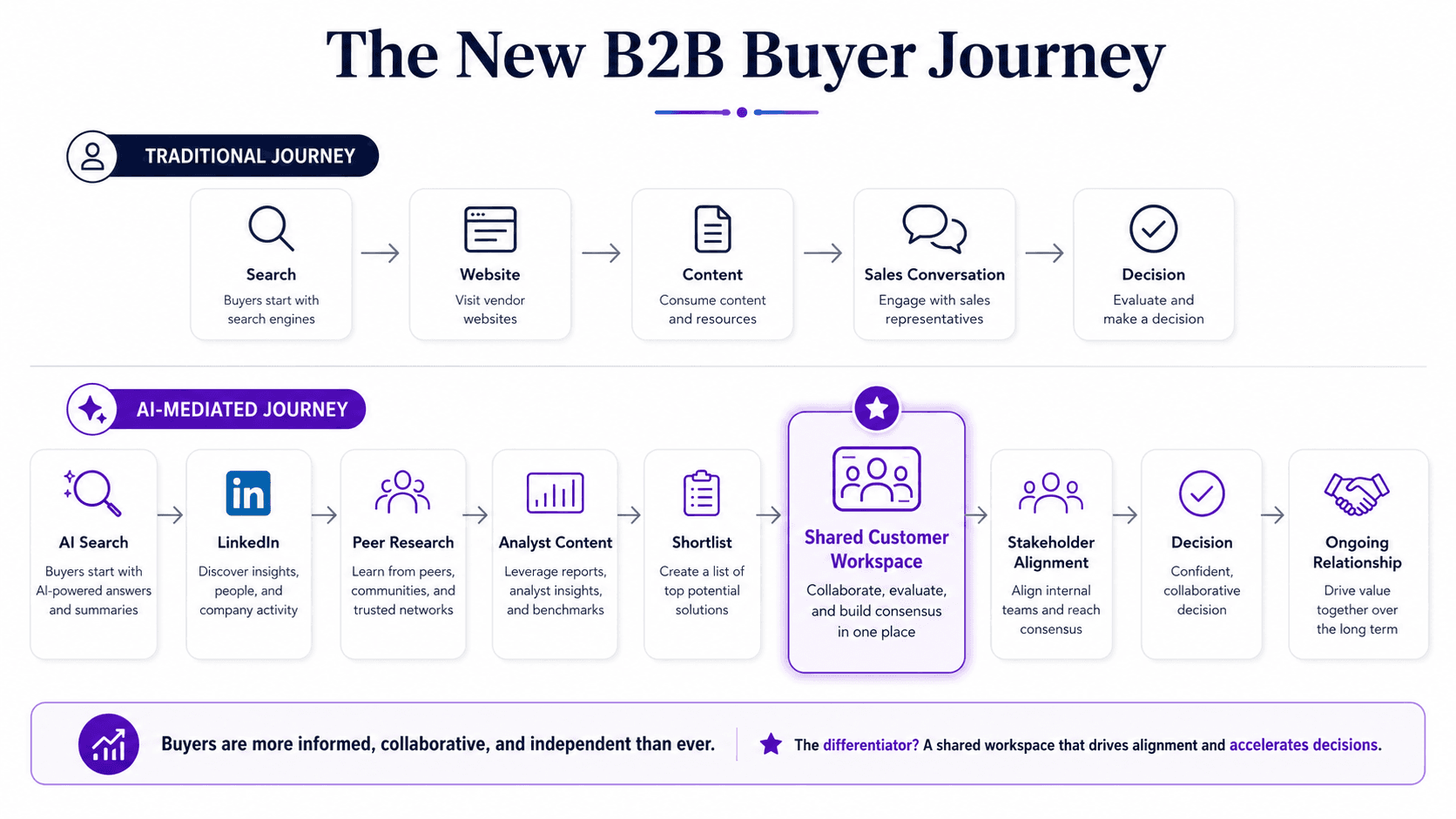
AI is compressing discovery, not eliminating the buying journey
The shift toward AI-led research is easy to interpret as buyers simply needing salespeople less. The reality is more nuanced.
6sense's Buyer Experience research found that buying cycles shortened from roughly 11 months in 2024 to around 10 months in 2025, while buyers increasingly completed research before engaging vendors. It also found that buyers still averaged 16 interactions per person with the winning vendor.
AI is therefore not necessarily removing vendor interactions. It is changing when and why those interactions happen.
Buyers can increasingly use AI to:
- understand a market,
- compare approaches,
- identify potential vendors,
- summarize product information,
- analyze reviews,
- prepare questions,
- and build an initial shortlist.
By the time they engage a vendor, they may already know far more than the traditional buyer who arrived through a gated whitepaper or demo request. That changes the job of the vendor.
The challenge is no longer simply: How do we provide information? It becomes: How do we help an informed buying group turn fragmented information into a coordinated decision?
Discovery is becoming easier. Evaluation may become more fragmented.
AI can synthesize enormous amounts of information for an individual buyer. But enterprise decisions are rarely made by one individual.
A complex opportunity might involve a business champion, an economic buyer, IT, security, procurement, legal, finance, implementation teams, and executive sponsors. Each stakeholder enters at a different point, asks different questions, and consumes different evidence — often asynchronously.
One stakeholder may read a case study. Another receives the security documentation. Procurement works from a pricing file. The champion forwards an old presentation internally. Someone else joins three weeks later and asks the seller to explain everything again.
AI may make finding information dramatically easier while leaving coordinating the decision just as difficult — and may amplify the problem by creating even more sources, summaries, and information paths for buying groups to reconcile.
The next generation of B2B experience needs to address more than discovery. It needs to create continuity.
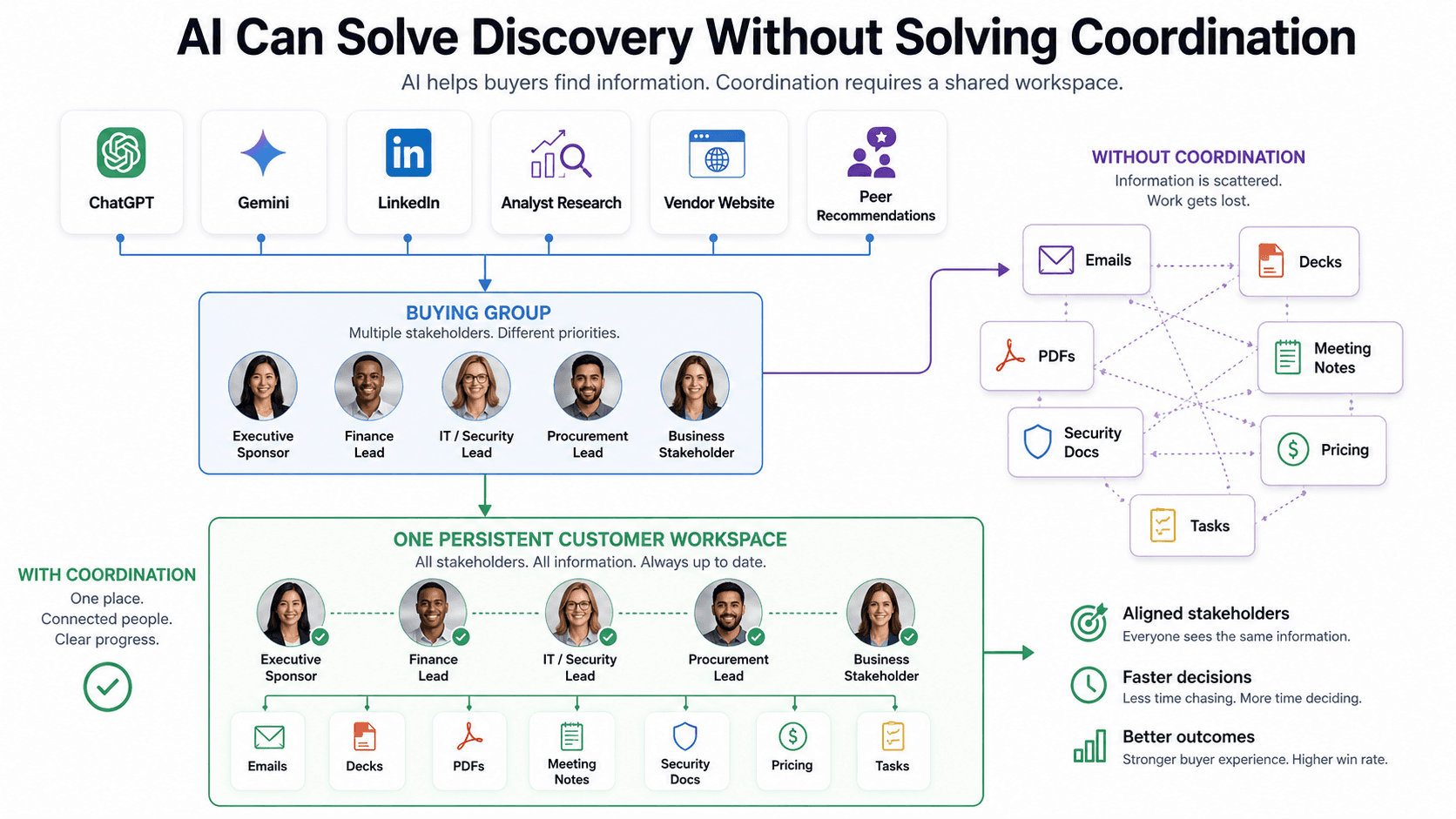
The missing layer is a persistent customer workspace
Most B2B technology stacks are optimized around the company selling. CRM records the opportunity. Marketing automation manages campaigns. Content systems store assets. Meeting platforms capture conversations. Sales intelligence surfaces signals. Customer success systems monitor post-sale health.
All of these systems are valuable. But the buyer often gets emails, attachments, meeting links, follow-up documents, shared folders, spreadsheets, task lists, security questionnaires, and different messages from different members of the vendor team.
That creates a missing layer between the company's systems and the customer relationship: a persistent workspace for the account itself — not simply a file repository, not simply a portal, and not merely a late-stage digital sales room.
As we've argued in AI in B2B sales and the customer workspace, that shared layer is where people, content, milestones, conversations, and intelligence stay connected. LinkedIn's AI-search shift makes the gap more urgent: when discovery happens off your website, the post-discovery experience has to hold the relationship together.
SmartRoomsXP approaches this as a broader Customer Engagement Platform: a shared workspace that can bring content, mutual action plans, communications, stakeholder activity, analytics, and AI-assisted intelligence into the context of an ongoing customer relationship.
Keep AI-informed buying groups connected
See how SmartRoomsXP customer workspaces turn fragmented discovery into continuous account engagement — from shortlist through renewal.
From attracting attention to helping buying groups make progress
LinkedIn's guidance focuses heavily on becoming discoverable in AI search — authority around a small set of themes, coordinated company and employee voices, long-form articles and shorter posts, and consistent signals AI systems can recognize. Those are important changes at the top of the buyer journey.
But companies should also rethink what happens once that attention becomes account engagement.
Funnel model
Generate demand → Capture lead → Hand to sales → Send content → Follow up
Relationship model
Build preference → Get discovered → Create account context → Engage the buying group → Collaborate → Decide → Onboard → Expand → Renew
The first model optimizes a funnel. The second manages a relationship. The workspace created for an opportunity should not necessarily disappear when the contract is signed — it can evolve into an onboarding hub, implementation workspace, success-plan environment, Executive Business Review hub, renewal workspace, or expansion plan. See how that maps across sales, ABM, onboarding, and customer success.
AI makes connected customer context even more important
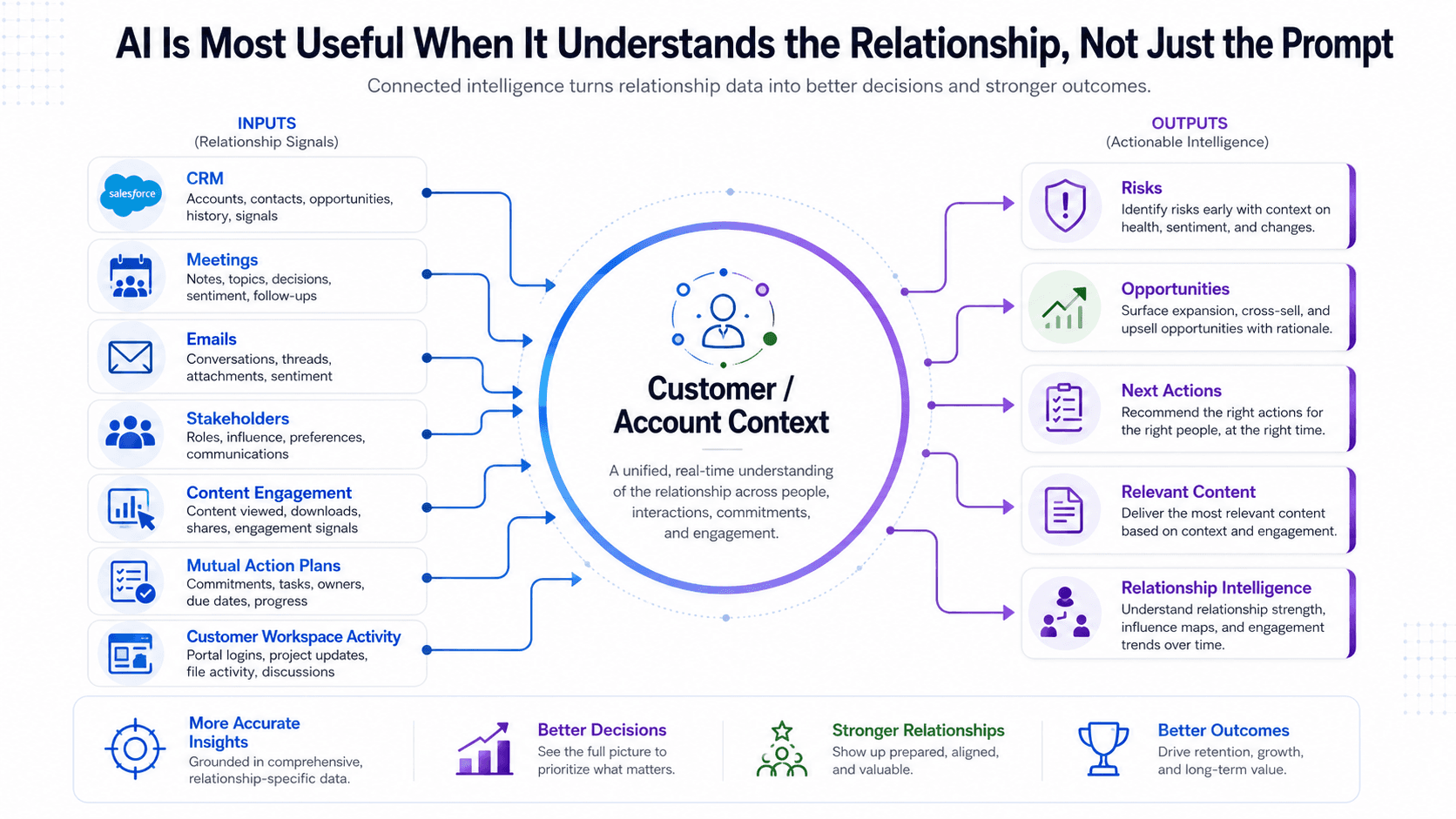
Companies are also embedding AI into their own revenue and customer workflows — analyzing meetings, email threads, stakeholder relationships, engagement, account activity, content consumption, commitments, risks, and next actions.
But AI becomes far more useful when these signals share context. An AI model analyzing one meeting transcript knows what was said. An AI system operating with account context can potentially understand who said it, what role that person plays, what happened earlier, what commitments are outstanding, which stakeholders are engaged, what content the account has consumed, and what the team should consider next.
SmartRoomsXP's enterprise AI is built around this idea of context-aware, governed enterprise AI — with account, room, stakeholder, CRM, and engagement context operating through permission-aware controls rather than as an isolated chatbot.
AI becomes more valuable when customer intelligence and customer engagement share the same context.
The future B2B journey may have three distinct layers
A useful way to think about the emerging B2B journey is through three connected layers.
Layer 1
Discovery
Increasingly decentralized across AI assistants, professional networks, thought leadership, analysts, peers, communities, search, and vendor content. Companies need visibility across this wider ecosystem — not only traditional search rankings.
Layer 2
Engagement
A customer workspace centralizes latest content, stakeholder-specific information, business cases, security docs, FAQs, proposals, mutual milestones, and ongoing communication — so buyers do not reconstruct the vendor story across channels.
Layer 3
Intelligence
Engagement creates signals: who is active, what content matters, who has gone quiet, which roles are missing, what commitments are overdue. Connected account intelligence informs the next appropriate action.
Together these layers form a continuous loop rather than a linear funnel: Discovery → Engagement → Intelligence → Better Engagement.
This also changes the role of the website
None of this means the B2B website becomes irrelevant. LinkedIn itself says optimizing for AI discovery should complement rather than replace strong SEO foundations.
But the role of the website may evolve. Historically, a website was expected to educate the market, explain the product, establish credibility, capture demand, host resources, provide proof, and move buyers toward sales. In an AI-mediated world, some discovery and education increasingly happens elsewhere.
The website remains the authoritative public expression of the company. Once a specific account begins engaging, a generic website may no longer be the best environment for the next phase — which can become personalized, persistent, collaborative, and account-aware.
The public website explains what the company does. The customer workspace helps a specific customer move forward.
B2B companies should prepare for the post-discovery experience
The immediate response to AI search is understandably focused on discoverability. Companies should ask whether AI understands what they do, whether they are associated with the categories they want to own, whether third-party content reinforces positioning, and whether content is structured clearly enough for AI systems to parse.
Revenue leaders should add another set of questions:
What happens when an AI-informed buyer reaches us?
Can the buying group find everything without searching email?
Does a new stakeholder understand account history immediately?
Are next steps shared between both organizations?
Is everyone working from the latest information?
Can sellers see where engagement is strengthening or weakening?
Does customer context survive marketing → sales → success handoffs?
Can AI operate on governed account context — not disconnected fragments?
Those questions go beyond AI search. They point toward the architecture of the modern customer relationship.
Customer workspaces
Persistent account environments for content, stakeholders, and mutual action plans.
See workspacesRelationship intelligence
Understand who is engaged, who is missing, and how the buying group is progressing.
Explore productContext-aware AI
Governed enterprise AI that operates on account and engagement context — not isolated prompts.
Explore AIThe next competitive advantage may be continuity
AI is making information abundant. That makes clarity, context, and continuity more valuable.
The brands that win the next generation of B2B buying may not simply be those that generate the most content or rank highest for the most keywords. They may be the companies that do three things exceptionally well:
Get discovered
Earn visibility across AI search, networks, and trusted third-party signals.
Create confidence
Give buying groups clear proof, context, and a coherent account narrative.
Enable progress
Make it easy for the entire customer organization to move forward together.
LinkedIn's AI search research offers an important look at how the first of those is changing. The opportunity for revenue and customer teams is to redesign everything that happens next.
Because in an AI-mediated buying world, being found is increasingly only the beginning. The larger challenge is keeping the relationship connected once the buyer finds you.
Being discovered by AI is only the start. Continuity after discovery is the advantage.
Frequently asked questions
How is AI changing B2B buyer discovery?
Does AI-led research mean sales conversations matter less?
What is a persistent customer workspace?
How does this relate to AI search optimization on LinkedIn?
Why does account context matter for enterprise AI?
Turn AI discovery into connected customer engagement
Start a free trial of SmartRoomsXP — customer workspaces, relationship intelligence, and context-aware AI in one engagement platform.
Sources: LinkedIn Marketing Solutions, “New Guide: How B2B Marketers Can Dominate AI Search on LinkedIn” (August 11, 2026); 6sense, 2025 Buyer Experience Report. SmartRoomsXP is not affiliated with or endorsed by LinkedIn or 6sense.